As the snow falls heavily today, we will be closing our office early so that our staff can get home safely.
The office will officially close at 1:00PM and all afternoon appointments are cancelled. We are planning on being open for business on Thursday, Dec 17th, but if you have an appointment, please call the office first to be sure we are open and able to see your pet. Stay safe and enjoy the snow day!
Weekly Update 03/28/20
As the COVID 19 situation continues to become more serious, we remain open and expect to continue to do so. While it is challenging to serve our patients, we feel it is very important that we do continue. One of the things we have done to improve efficiency is to make some of the forms we are using available for download. This way you can complete the form and get it back to us before your appointment, and it eliminates another physical object to handle. These forms can be emailed to: info@palmeranimalhospital.net or faxed to 301-371-0019.
Is Your Dog Eating a Grain-Free Diet? Time To Re-Evaluate
If your dog is eating a grain-free diet, it’s time to change. This past July (2018), the Food and Drug Administration (FDA) alerted pet owners and veterinary professionals about reports of canine dilated cardiomyopathy (DCM) in dogs eating grain-free or “boutique” foods. The exact cause of these cases of DCM is not clear. In some dogs it appears to be related to low levels of an amino acid called taurine, but in many other dogs low taurine levels are not the cause. Often times we hear reports like this in the news and they are quickly forgotten, but this is a REAL problem. Veterinary cardiologists are seeing these cases on a continual basis, and the cases are occurring in dog breeds that don’t commonly have DCM.
What should a pet owner to do when there are still so many questions out there? It is important to choose a diet for your pet that is completely balanced. Make sure the food meets the Association of American Feed Control Officials (AAFCO) for both nutrient levels and feeding trials. Many owners will be shocked to know that not all foods meet either standard. Veterinary nutritionists recommend feeding a diet made by a well-known, reputable company that contains standard ingredients such as chicken, beef, rice, corn and wheat. Veterinary nutritionists state that you should be less fixated on the ingredient list of the diet and more concerned with the research behind it. Most dogs do not need a grain-free diet, but if your pet does truly have a dietary allergy, there are quality products available. Please feel free to ask our doctors or staff about recommendations for your pet. Below you will find a Q&A section to further answer questions and to provide more detail:
What was reported by the FDA about grain-free diets for dogs?
In July 2018, the FDA posted that cases of dilated cardiomyopathy had been reported in dogs eating grain-free diets containing peas, lentils, other legume seeds, potatoes, or exotic proteins as main ingredients. DCM is a disease of the dog’s heart muscle which becomes weakened and unable to properly contract. The heart chambers start to enlarge and dilate, and the heart is unable to effectively pump blood to the body. This leads to a build-up of fluid in the lungs, chest and abdomen resulting in congestive heart failure. Heart function may improve with medication, but this is a very serious disease that is difficult to treat.
What appears to be the cause of the problem?
Currently the cause of the problem is not clear. Some dogs appear to have low levels of an amino acid called taurine, but in other dogs the taurine levels are normal and the exact cause is not known. The only thing that is clear is that this is a real problem that veterinary cardiologists are seeing on a routine basis. Both the typical and atypical breeds were more likely to be eating boutique, grain-free diets, or diets with exotic ingredients such as kangaroo, lentils, duck, pea, fava bean, buffalo, tapioca, salmon, lamb, barley, bison, venison, and chickpeas. Even some vegan, raw, and home-cooked diets have been associated.
What breeds appear to be affected?
There are breeds of dogs such as Boxers, Dobermans, Irish Wolfhounds and Great Dane where DCM is commonly seen and is genetically predisposed. This recent problem associated with grain-free diets is affecting many breeds of dogs, most of which do not commonly get DCM. The breeds reported include Golden Retrievers, Labradors, Shih Tzu, bulldogs, Schnauzers and Whippets. It is important to remember that this problem may occur in any breed of dog.
Why does my do need to eat a grain-free diet?
The answer is that dogs do not need to eat a grain-free diet. One of our continual concerns about grain-free diets is that they are advertised as healthier and hypo-allergenic, neither of which is true for most dogs. There is no scientific evidence that grain-free diets are healthier than conventional diets. Most of the information about grain-free diets comes from manufacturer advertising and is not based on scientific fact. For example, one “fact” that is often cited is that dogs are wolves and cannot digest or metabolize carbohydrates. But dogs are not wolves. Studies of the canine genome have shown that dogs have significantly increased ability to utilize carbohydrates in comparison to their wild cousins. Currently over 50% of all dog foods produced are “grain free”, and many are manufactured by smaller companies with fewer resources for the design, production, and monitoring of their diets. While there are dogs that do require a specialized diet due to dietary allergies or hypersensitivities, this is not true for the vast majority of dogs.
What do I need to look for in a dog food?
The first thing to always look for is the AAFCO (Association of American Feed Control Officials) certification on the package. This indicates that the food at least meets official nutrient requirements, and hopefully has also passed actual feeding trials. Other questions to ask are: Does the manufacturer employ at least one full-time qualified nutritionist? Does the manufacturer own the plant where the food is manufactured so they have more control over quality? What quality control measures does the manufacturer practice? Does the company conduct any research? Getting answers to these questions is not always easy, but it is important for your pet’s health.
What foods should I be feeding my dog?
Veterinary nutritionists recommend diets made by well-known, reputable companies that contain standard ingredients such as chicken, beef, rice, corn, and wheat. The FDA reported that the implicated diets usually contained legumes (peas, lentils, etc), potatoes, or exotic ingredients as their main components, so these should be avoided. Exotic ingredients have different nutritional profiles and have the potential to affect the metabolism of other nutrients. Every pet owner wants to feed their pet “the best” diet to keep them healthy, just remember to not always believe what advertising campaigns tell you. Choosing a proven and well-balanced diet is the safest option for your pet.
What ingredients should I be looking for to select a food?
Veterinary nutritionists state that the ingredient list can be one of the least reliable ways to choose a diet. We do recommend avoiding diets with the above listed ingredients as major components. The best way to select a diet is to ensure that the manufacturer has excellent nutritional expertise and rigorous quality control standards. This usually means a large nationally recognized brand. The concern is that many smaller or boutique companies are not doing more than the minimum of balancing their diet in the laboratory.
What if my dog truly has a food allergy?
While food allergies do occur in pets, the majority of those are related to protein (meat) sources and not the other components of the diet. For pets that truly do have food-related allergies, there are numerous appropriate well-balanced diets available. For a diet to be truly hypo-allergenic, it needs to meet one of two criteria. First, it can be novel and exclusive, that is contain only a single protein or carbohydrate source that the dog has ever eaten before in its life and use only those ingredients. The second option is to be formulated so that the protein source will not cause an allergic reaction, such as hydrolyzed protein diets. Hydrolzyed means the protein molecules have been broken down into smaller pieces that should not cause an allergic reaction. Most of the true hypoallergenic diets are not sold over-the-counter due. Remember that “hypoallergenic” means something different to every dog.
What about raw or home-cooked diets?
We NEVER recommend raw diets due to the significant risk of bacterial contamination. Studies have shown that 40% of these type of diets can be contaminated with bacteria such as Salmonella and Campylobacter. The AVMA, FDA, and American Animal Hospital Association also do not recommend raw diets for pets due to risk of infectious disease to pets and their owners. Home cooked diets can be an option, but they need to be properly balanced and prepared. We commonly use home-cooked diets for short term feeding in certain medical cases, but for long-term feeding it is extremely important to be certain they are properly balanced (by a veterinary nutritionist).
Do I need to supplement my dog with taurine, or have their blood level checked?
While low taurine levels were found in some of the diet-related cases of DCM, it is not the cause in all of them. Blood taurine levels can be checked, but need to be sent to a specific laboratory and the testing is not inexpensive. The first question I would ask myself is why do I need to this if my dog’s food is truly high quality? Supplementing with taurine is fairly easy and inexpensive to do, but again, your pet’s food should be completely balanced and not require additional supplementation.
What other precautions or testing is recommended?
In articles about this problem, numerous recommendations have been made for dogs eating one of the implicated types of diets. Some recommend monitoring your pet for early signs of heart disease such as weakness, slowing down, exercise intolerance, difficulty breathing, coughing or fainting. The problem of waiting for these signs to develop is that by that point, the heart disease is well advanced and will be difficult to treat. Some dogs can go from appearing normal to having life threatening DCM within a matter of days. Also keep in mind that once the disease appears, it can take months for your pet to respond to therapy, changes to their heart may be permanent, and some may not respond at all. It has also been recommended to have your dog examined by a veterinary cardiologist and have an echocardiogram performed. Echocardiograms may detect changes sooner, but by then there are already significant changes to your dog’s heart muscle. Another recommendation is checking blood taurine levels, or supplementing the diet with taurine. As mentioned above, not all of these cases have low taurine levels. With all of these recommendations, ask yourself why do you need to be doing this if a diet is truly well-balanced? The best recommendation of all is to change your pet’s diet.
What specific brands of dog food do you recommend?
There are many brands and varieties of dog food available that can keep your dog healthy. Everyone has an opinion on pet food and feels that their food is “the best”. As a business, we carry Hill’s (Science Diet and Prescription Diets), Purina, and Royal Canin. Personally, as a breeder of Standard Poodles for over 25 years, Dr. Palmer and his wife have always used Hill’s Science diet. While no one diet works perfectly for every dog, there are many good options available .
Phone Problems 05/16/18
Today we are having phone issues that appear to be related to the weather. Our main phone line is not working and also not rolling over to our other lines. If you need to reach us today, you can call 301-371-6120 or 301-371-6154. Note that our fax line is also down at this time so we cannot receive any faxes. We hope to have this situation resolved by this afternoon. Thank you for your patience.
Palmer Animal Hospital Solar Update
It’s official—Our solar project went “LIVE” today, and our electric meter is actually running backwards on this sunny day as we are making more power that we are using.
The array is pumping out a near max 38 kW of power and we are happy to see things working so well. Be sure to check out the solar array and the monitor in our waiting room
on your next visit!
Palmer Animal Hospital Solar Project
If you have visited our office recently, you have noticed some activity out in our fields. We have decided to join the “green revolution” and install a solar array for our office. This array is not on our building though. Since we have plenty of land, we decided to put in a ground-based system. This allowed us to make it as large as needed to meet our electrical needs and to face the array in the most ideal direction. It should be generating electricity before Christmas, and after that we should have hardly any electric bill at all.
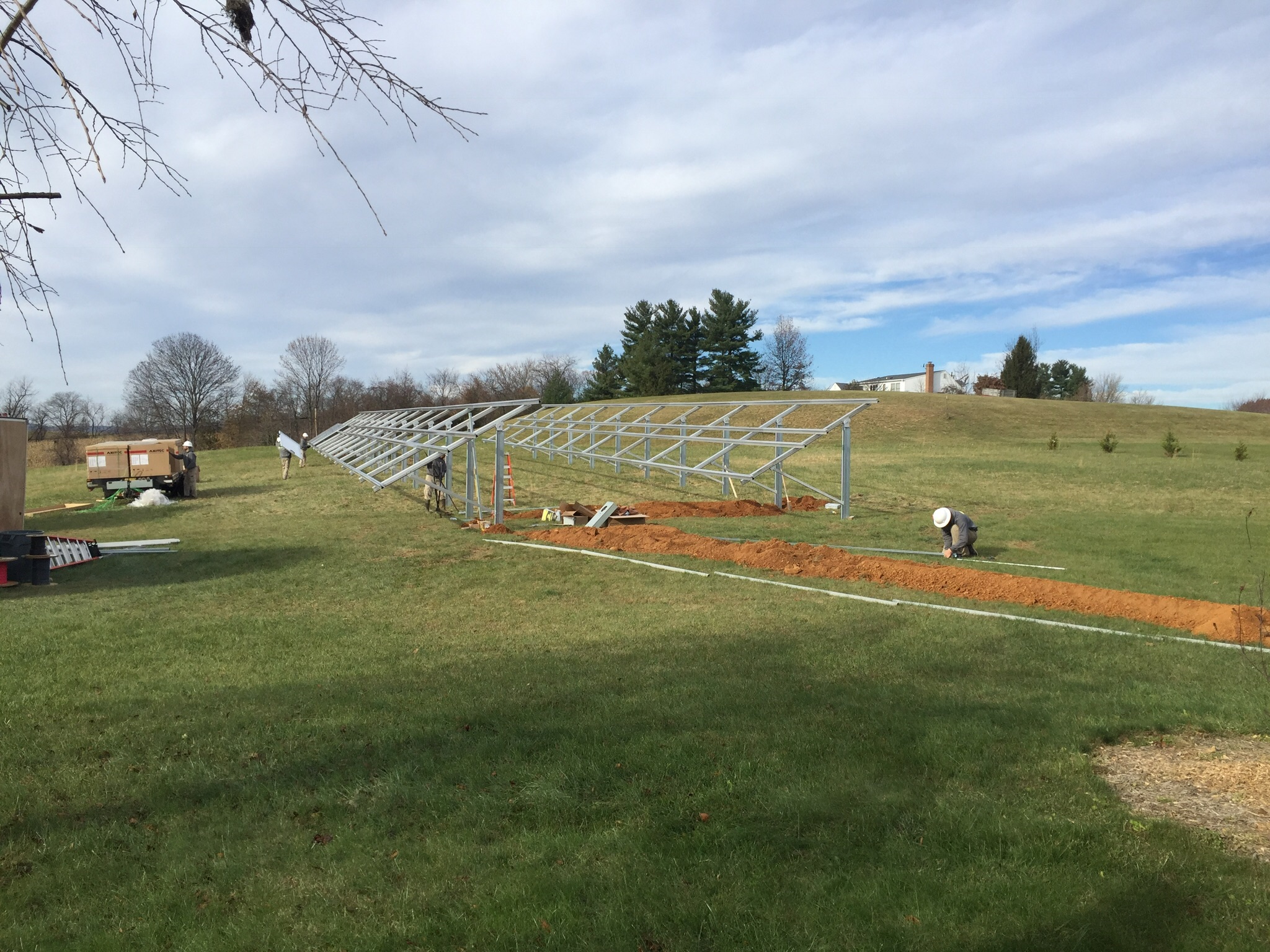
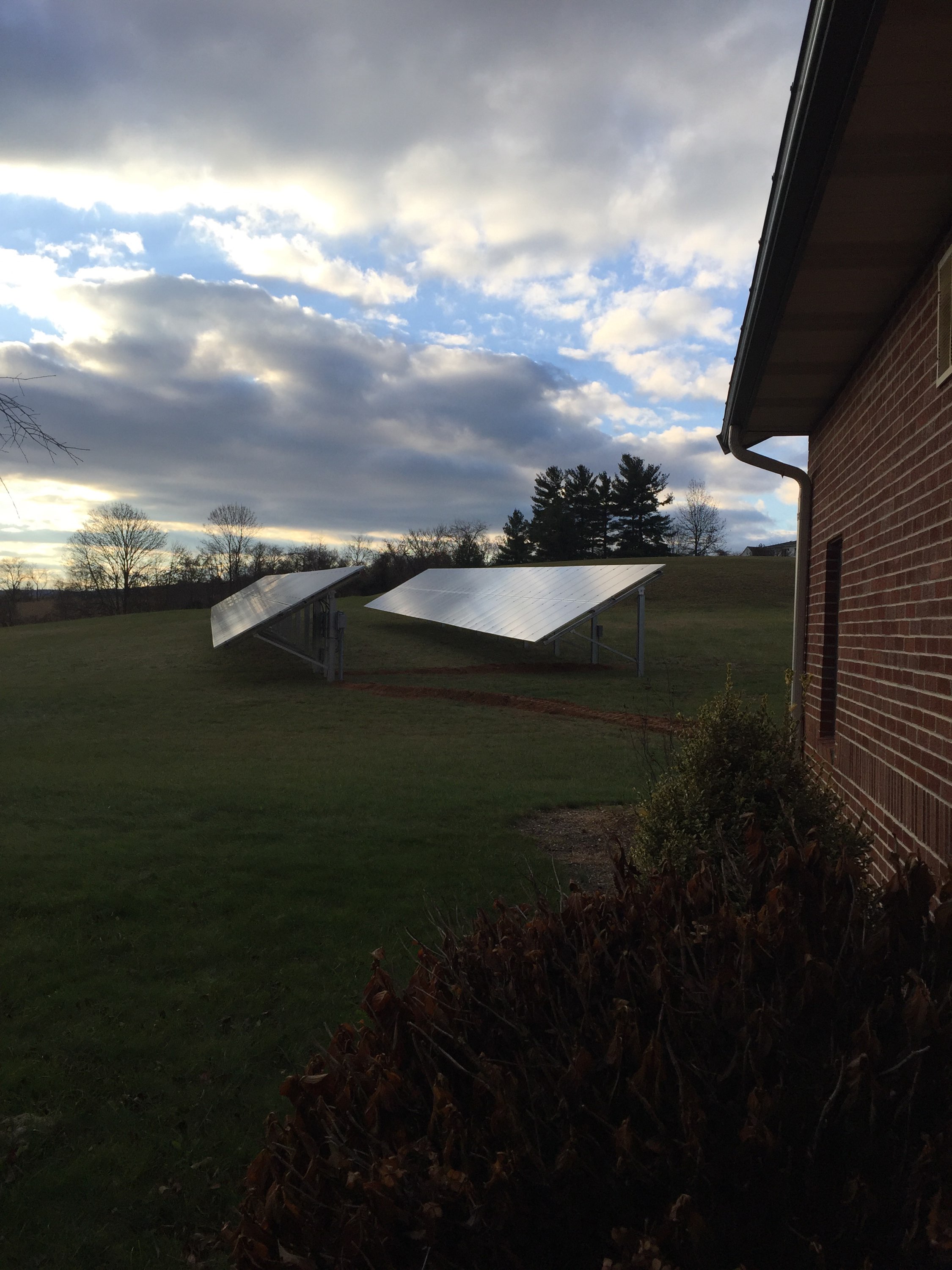
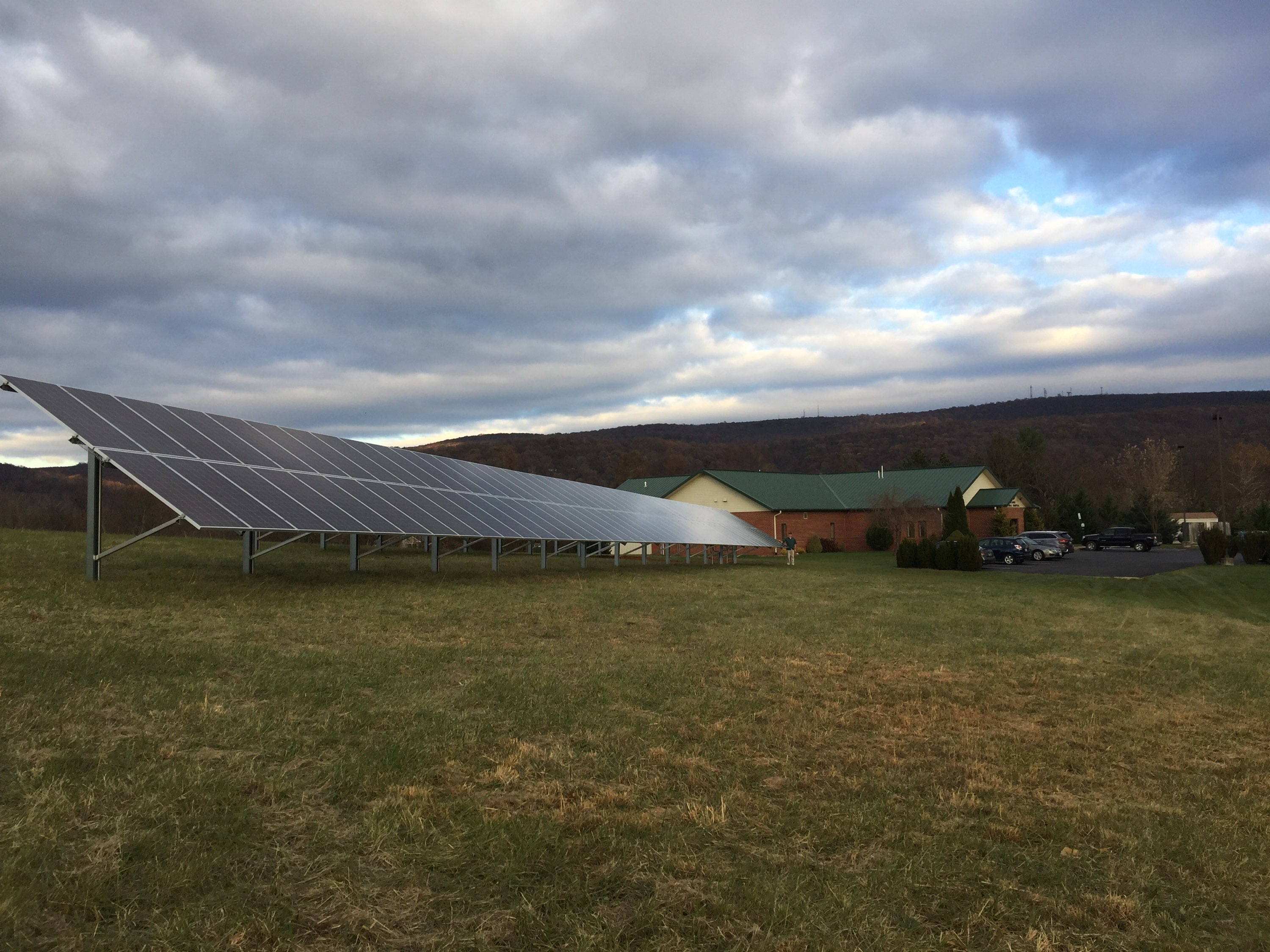
Some facts about our solar array:
–We use about 59,000 kWh of electricity per year at a cost of about $8000 annually. This array is designed to produce 99% of that amount and leave us with a minimal electrical bill. (NOTE: it generally is not cost-effective to overproduce electricity because the utility then only pays you wholesale rates).
–This is an ideal location for solar panels because they are elevated on a hill where they should never be shaded and they are oriented to within 1 degree of facing south.
–The production of the panels is guaranteed for 10 years by Paradise Energy. The panels have a life expectancy of 25 years, and there is a small drop in production as they age (approx 0.5% per year, so after 25 years they will produce 12% less)
–During the day, our electrical meter should actually be running backwards. At the end of a year, if we produce more electricity than we use, the utility will pay us. This is possible because with our ideal location, the production of the array could be slightly greater than anticipated.
–There are significant tax saving for building a solar project, especially for a business. With tax credits, depreciation, and electrical production, the array will pay for itself in about 7 years, and then we will have a very, very small electric bill.
–Unfortunately, the solar array will not operate when the electrical grid power goes down. This is a safety issue because the array cannot backfeed the grid during outages. We could avoid this problem by installing a battery system, but the expense and current technology do not quite make that cost effective.
–The array was constructed by driving metal posts 7 feet into the ground and attaching a rack system. The array is supposed to resist winds upto 130 mph. Let’s hope it doesn’t ever get put to the test on that!
–There are two sets of panels in our array consisting of a total of 150 panels. The smaller set is 100 feet long with 60 panels, and the larger one 150 feet with 90 panels. These panels feed into 5 inverters that convert the DC electricity from the panels into AC current the powers our building and backfeeds and extra to the grid.
–We actually had to upgrade our electrical transformer (that big green “box” towards the rear of our building) because it wasn’t big enough to handle all the power this array will generate. The original transformer was 25kW, and our array will generate 38kW.
–There will be a monitor in our waiting room showing us how much power we are making—be sure to check it out next time you are in our office
2018 Holiday Hours
Hope everyone is having a great year. The Holiday Season is fast approaching and both Christmas and New Years Day are on a Monday this year.
Our holiday hours will be as follows:
Sat, Dec 23rd 8AM-12N (regular hours)
Mon, Dec 25th CLOSED
Tue, Dec 26th 8AM-8PM (regular hours)
Sat, Dec 30th 8AM-12N (regular hours)
Mon, Jan 1st CLOSED
Tue, Jan 2nd 8AM-8PM
We always try to take care of our patients as much as possible over the holidays, but there are always things that come up. If you need medical care for your pet when we are closed,
you can contact one of the emergency hospitals in our area (both are open 24/7):
CARE
1080 West Patrick Street
Frederick, MD
301-662-2273
Mountain View Animal Emergency
18501 Maugans Ave #105
Hagerstown, MD 21742
301-733-7339
Beware Heartworms
Its that time of year again to protect your pets from heartworms. Mosquitoes transmit heartworms from dog to dog in the spring, so it is time to get your pet into a Veterinarian and tested for heartworms. To start your pet on prevention, a veterinarian will draw blood and run a test. If the test is negative they can start on heartworm prevention such as HeartGard. Prevention for your pets should start around April 1st to December 1st. Here at Palmer Animal Hospital we believe year-round prevention is best for two reasons. First, if the prevention is stopped for the winter, your pet will have to be tested every year. If your pet is on year-round prevention they will be tested every other year. Secondly, if your pet stays on heartworm prevention year-round, it is easier to remember to give it every month and you are less likely to forget the medication. Prevention is definitely recommended instead of treatment. Heartworm treatment may be long and painful. dogs and cats of all ages are susceptible. Heartworms spend their adult life in an animals heart or pulmonary arteries, could cause right-sided heart failure. Signs can vary from nothing at all to persistent cough, fatigue, fainting, and weight loss. Heartworms are serious and can be fatal. So bring your pet into your veterinary hospital and get your pet tested for heartworms.
Beware When Purchasing Pet Products Online
Many pet owners like to buy their products online, but they don’t always know what they’re actually getting. When you order online products make sure its from a trusted source. If not the product you order may be ineffective or dangerous for your pet. For example, a customer bought Frontline Plus online for his two cats. Frontline is supposed to kill fleas, flea eggs, and ticks but when they gave their two cats a dose of Frontline they went from having a few stragglers to a full-blown flea infestation. Since this product didn’t seem to kill the fleas like it was supposed to, one cat started to get a really bad flea allergy and the other started to get sick at the same time. Be cautious of where your product is coming from; unknown sources may provide fraudulent product or one only available in other countries. These products are not legal in the US, probably will not be effective, and may be harmful to your pet. There are different ways to make sure you are getting safe, effective products for your pet. Purchasing from a veterinary hospital is usually the best way to go because veterinarians buy directly from the manufacturer. Online products are often diverted through 2nd or 3rd parties. If buying online be sure you are purchasing from a reputable site. Be sure to check the package graphics, they should match with an authentic box. Keep in mind the even when buying authentic product from a unauthorized online source, manufacturers will not honor the product warrantee if something a problem occurs. Veterinary medicine is nothing to joke about, if you want the best product for your pet buy it from a trusted source.
Electronic Reminders
With the arrival of the New Year, we are planning on trying to catch up with the age of technology by using electronic reminders. This means that we will be sending out emails and texts to 1) remind you about health care services your pet is due for such as Annual Well Pet Exams, Vaccinations, and Routine Testing; and 2) to confirm and remind you about existing appointments. We think is a great step forward as it will be much more convenient for our clients as well as our staff. These electronic reminders will start to replace the postcard system we have used for years as well reduce the number of phone calls made by our staff.
If we do not have an email address or cell phone associated with your account, you will likely be contacted by a staff member for that information. If you continue to receive postcards from us, it means we do not have email or cellphone information on your account and you should contact us with that information. If you do not wish to receive emails or text reminders, please let us know and we can mark your computer file appropriately.
Note that we will still be calling all of our anesthesia/surgery/procedure cases the night before to re-confirm and to remind you to fast your pet as required.
Please feel free to call with any questions, or better yet, to update your file with an email address and phone number!